5.1 Demonstrate ability to administer and integrate assessment, instruction, intervention, and differentiation across the components in reading in a comprehensive instructional program.
Monitoring the students during a lesson
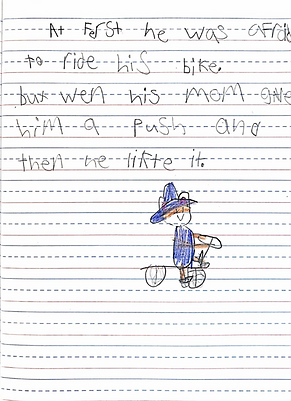
During this lesson, I made sure that I carefully monitored my students as they completed the different activities that I planned out for them. One instance where this can be seen is during the independent writing activity. During this activity, I had my students write a summary of the text that they just read and create a drawing of an event that happened in this story. The purpose of this activity was to assess my students’ comprehension skills and their ability to write an effective summary that describes what happened in the text from beginning to end. As my students were writing their summaries, I made sure to monitor them to see how they were writing. I watched them to make sure that their summaries were an appropriate length and they described an event that happened in the story. During the activity, I encouraged my students to write one more sentence to make sure that they had a clear enough summary. I am making adjustments to my lesson based on the performance of my students, the needs of my students, and to collect data on them for future lesson plans. This meets Reading Competency Indicator 5.1 since I am demonstrating an ability to differentiate reading instruction.
Artifact: Observation #1- Professor
5.2 Use assessment and data analysis to monitor student progress and inform instruction over time to ensure an increase in learning for all students, including students with identified reading deficiencies and those with characteristics of dyslexia.
Analyzing student data to design Phonics Instruction
As I was planning this lesson, I decided to utilize explicit phonics instruction to help my students read some of the key vocabulary words. In order to determine which words my students would benefit from having instruction in, I decided to use some data from a previous Lexia Assessment of one of my students. This assessment primarily focused on phonics, phonemic awareness, and comprehension. Using this data, I was able to determine that the students in this group needed to have their explicit phonics instruction with words that have the CVCC/CCVC pattern. The purpose of using this data was to determine which words my students needed instruction in demonstrating how to decode these words. As I completed the lesson with my students, I was able to see that my students benefited from this instruction since they could read those words in the text without any issues. Using data to build my instruction benefited my students since they were able to have their needs met. This meets Reading Competency Indicator 5.2 since I’m using student data to inform my instruction and lessons for my class.
Artifact: Student Lexia Data- Lesson #3
5.3 Demonstrate evidence-based practices for developing oral/aural language development for all students, including students with identified reading deficiencies and those with characteristics of dyslexia.
Background knowledge development with images
At the beginning of this lesson, I decided to pre-teach the key vocabulary to my students in order to help them activate their background knowledge that is needed for the lesson. To help improve their ability to grasp the vocabulary terms, I used pictures as visuals to help them connect the terms to imagery that they are familiar with due to their prior experiences. During this activity, I would show my students a picture of an animal, ask them what they think the animal is, and then reveal what animal it is after I collected their responses. The purpose of this activity was to review the important vocabulary with my students so I could assess their knowledge of these terms, see which terms my students might need to work on during the lesson, and to see if they could read these terms in the book. This activity helped my students a lot since they were able to do the future activities in the lessons without any issues regarding the vocabulary. This meets Reading Competency Indicator 5.3 since I am using an evidence-based practice, building on background knowledge, to help develop my students oral/aural language skills.
Artifact: Instructional Design Artifact (Pictures)- Lesson #3
5.4 Demonstrate evidence-based practices for developing students’ phonological awareness and phonemic awareness for all students, including students with identified reading deficiencies and those with characteristics of dyslexia.
Emphasizing vowel sounds and identifying similar/different vowel sounds
In this lesson plan, I focused on using evidence-based strategies for phonics that would improve my students phonemic awareness skills. I primarily focused on having my students identify similar and different long vowel sounds in words. This is demonstrated during my Direct Instruction as I focus on having my students give me a thumbs up/down if a long vowel sound is similar or different in a pair of words. An example of this would be me saying “striiiiipe…..striiiiike” and having my students decide if those sounds are the same or different from each other.
Artifact: Instructional Design Artifact- Lesson #1
5.5 Demonstrate evidence-based practices for developing phonics skills and word recognition for all students, including students with identified reading deficiencies and those with characteristics of dyslexia.
Explicit, systematic phonics instruction
During this lesson, I made sure that my students were able to complete evidence-based practices that would help my students improve in phonics. At the end of this lesson, I used Elkonin Sound Boxes at the end of the lesson to help with phonics. This is a strategy that can be used to help students improve their ability to segment phonemes and blend sounds, a skill that is important for phonics. Elkonin Sound Boxes is a highly effective evidence-based practice that teachers can use with their students during reading instruction to help with phonics. You write an individual sound into each box, and then drag your finger across the word/boxes as you blend the sounds together to say the word. This meets this Reading Competency Indicator 5.5 since it is heavily connected to phonics instruction.
Artifact: Elkonin Sound Boxes- Lesson #1
5.6 Demonstrate evidence-based practices for developing reading fluency and reading endurance for all students, including students identified with reading deficiencies and those with characteristics of dyslexia.
Using echo reading strategy before they read the text independently
In this lesson, I decided to use an instructional strategy that would help develop my students’ reading fluency and reading endurance skills. One strategy that can be seen being used during this lesson was Echo Reading. This strategy required my students to listen to me as I read one part of the text fluently, and then reading the same part of the text back to me fluently as well. I decided to use this strategy since it would help my students be able to read the text since I am directly modeling how it should be read with fluency and I am then having my students repeat it back to me after I model it. As I had my students read through the text, I made sure to monitor them to see if they were able to read with fluency. If I noticed that my student made a mistake such as a substitution or omission, I would remind them to be careful and to not read so fast. This supports ELLs and other students with reading difficulties since I am modeling fluent reading for them in order to help them read the text with accuracy and at a good rate. This meets Reading Competency Indicator 5.6 since I am using an evidence-based strategy to help my students improve in reading fluency and endurance.
Artifact: Observation #2- CT
5.7 Demonstrate evidence-based practices for developing both academic and domain-specific vocabulary for all students, including students with identified reading deficiencies and those with characteristics of dyslexia.
Vocabulary picture matching worksheet
Being able to identify key vocabulary words based on picture clues was a big focal point of this lesson. I included various activities throughout this lesson that would help my students improve their word recognition skills. At the end of this lesson, I had my students complete a matching worksheet of the pictures and the vocabulary terms. In this activity, they would find a vocabulary word and draw a line to the image of an animal that is associated with the word. The purpose of this activity was to assess my students’ vocabulary knowledge and to see if they can identify vocabulary words based on picture clues. After my students completed the activity, I looked at their worksheets to see if they were able to get all of the words matched to the images correctly. This worksheet supported my students with specific learning needs since they were able to have pictures that they could associate the words with. It also helps my ELLs with vocabulary acquisition since they are able to reinforce the terms with the images. This meets Reading Competency Indicator 5.7 since I am using evidence-based strategies, vocabulary matching activities, to help develop academic or domain specific vocabulary for my students.
Artifact: Vocabulary Picture Matching Worksheet- Lesson #3 Professor
5.8 Demonstrate evidence-based practices for facilitating reading comprehension for all students, including students with identified reading deficiencies and those with characteristics of dyslexia.
Asking questions about the text
I was able to implement many different evidence-based strategies that would support my students and help them improve their comprehension skills. One strategy that I used during this lesson was asking questions about the text that they read. An example of this would be me asking if a character in the text was feeling brave or afraid, and I then had my students give me their responses. Another strategy that I had my students practice to help improve comprehension was citing text evidence to support their answers. I did this by having them read a sentence from the text that they thought supported their answer to a question. This meets Reading Competency Indicator 5.8 since it supports improving comprehension through using evidence based strategies.
Artifact: Instructional Design Artifact- Lesson #1
5.9 Demonstrate evidence-based comprehension practices for developing students’ higher order thinking to enhance comprehension for all students, including students with identified reading deficiencies and those with characteristics of dyslexia.
Writing a summary of a text and creating a drawing
One activity that I had my students complete during the lesson was writing a summary of the text that they just read and creating a drawing of an event in the book. This activity supports comprehension since it involves understanding a text that you read and writing a summary of what happened in the text from beginning to end. The drawing also helps them understand the text since it involves making an illustration that demonstrates an event that happened in the text. This activity also supports higher-order thinking since summarizing a text requires evaluating a text and you are also creating a drawing in your journal. Evaluating and creating are all levels of Bloom’s Taxonomy. This meets Reading Competency Indicator 5.9 since it supports comprehension, supports higher-order thinking, and is connected to Bloom’s Taxonomy through creating and evaluating.
Artifact: Writing Journal Activity (Creating a Drawing/Writing a Summary of a Text)- Lesson #1
5.10 Demonstrate evidence-based practices to facilitate students’ monitoring and self-correcting in reading for all students, including students with identified reading deficiencies and those with characteristics of dyslexia.
Monitoring the students as they read the text to see if they make any errors
For this lesson, I decided to focus on my students being able to monitor themselves as they read a text and correct themselves if they made a mistake. One instance where this can be seen in this lesson plan is during the Echo Reading activity, which was the guided practice I did with them for this lesson. During this activity, I monitored my students as they read through the text and made sure that they were able to read it fluently. If a student made an error while they were reading, I would point it out to them and then encourage them to try rereading the text correctly. Another instance where this can be seen is during the Independent Reading activity. When I was giving my directions, I encouraged my students to monitor themselves and correct themselves on any mistake they make while they were reading. While they were reading, I was also monitoring my students to see if they were reading with fluency, making any errors while they were reading, and see if they were able to correct themselves. The delivery of this instruction aligned with my lesson plan since I was able to get my students to monitor themselves as they read. This is aligned with Reading Competency Indicator 5.10 since I am demonstrating evidence-based strategies that will facilitate self-correcting and monitoring in my students as they read through a text.
Artifact: Instructional Design Artifact- Lesson #2
5.11 Demonstrate evidence-based practices for developing all students’ background knowledge to enhance the ability to read critically, including students with characteristics of reading difficulties and dyslexia.
Activate prior knowledge to make connections to text
As a teacher, it is important to learn how to make your students understand the significance of the content that you are teaching them. One way to do this is to make connections to any prior knowledge that they have with the content that they are about to learn. This is demonstrated at the beginning of my lesson as I ask my students very basic questions to assess their understanding about the topic of the book. I asked my students to identify the animals that are present in the pictures. This helped my readers build a connection to the text since the plot of the text is about seeing various animals and asking them what they see. This could have activated the prior knowledge that my students might have about animals since they might remember seeing certain animals in the past. This might include having them as pets, seeing them at the zoo, or maybe finding them in the park. This meets Reading Competency Indicator 5.11 since involves activating background knowledge to enhance my students’ ability to think critically.
Artifact: Observation #3- Professor
5.12 Demonstrate differentiation of instruction for all students utilizing increasingly complex text.
Differentiation in writing activity to allow varied demonstrations of understanding
Every student shows their learning and understanding through different means. As a teacher, it is important to keep that in mind as some students might be able to show their understanding of a lesson through one demonstration, but they might struggle with a different demonstration. I kept this in mind during the independent writing activity that I planned out for my students. This is the case since I allowed my students to demonstrate their comprehension of the text through different means; these include writing a summary of a text and creating a drawing of an event in the text. This is a great example of allowing my students to demonstrate understanding through different means since I am giving my students an opportunity to write about what happened in the text and to draw what happened in the text. Some students might be able to show that they were able to comprehend the text by writing a summary of the text, and some students might show their comprehension of the text by creating a drawing of an event that happened in the text. This is connected to Reading Competency Indicator 5.12 since it involves differentiating instruction for my students.
Artifact: Writing Journal Activity (Creating a Drawing/Writing a Summary of a Text)- Lesson #1
5.13 Demonstrate skill in utilizing assessment data and instruction with English learners from diverse backgrounds and at varying English proficiency levels.
Reading Strips
I had some ESOL students in this small instructional group for a lesson that did focus on fluency and vocabulary. Since this was the case, I knew that I had to bring some reading supports to the table for my ESOL students. One of the supports that I used was Reading Strips. The students could use these to cover up parts of the text that they were not currently reading so they could focus on a certain line or part of the text, not get overwhelmed by other parts of the text, and so they would not read too fast causing them to make mistakes. The students were able to use this tool effectively as they covered the parts of the text that they weren’t reading, read at an appropriate rate, and not make any errors while reading. This meets the needs of my ESOL students since they need various reading supports in order to help them gain the skills that are need to improve fluency. This meets Reading Competency Indicator 5.13 since I am demonstrating skills in utilizing instruction with ELLS from different backgrounds at varying English proficiency levels.
Artifact: Instructional Design Artifact (Reading Strips)- Lesson #2
5.14 Create an information intensive environment that includes print, non-print, multimedia and digital texts.
Utilizing both digital and print texts in lesson
It is crucial that you use multiple forms of print in reading lessons to ensure that they are effective. During this lesson, I use various types of print that would help my students become more effective readers. The primary form of media that I used during this lesson was the printed text, or the Giraffes book. This book was rich of valuable content about the main topic and the key vocabulary words that I had my students memorize. With this text, I paired it with a PowerPoint presentation about the vocabulary. In this presentation, there would be an image on one slide, and then the vocabulary term on the other slide. I used this presentation to help pre-review the key vocabulary words with my students and to help them get familiarized with these terms due to their background knowledge. I would ask my students what they think is being shown in the image, and then I would reveal the correct vocabulary word associated with the image. This supports Tier 2/Tier 3 students since I am providing visual supports paired with the vocabulary words. This meets Reading Competency Indicator 5.14 since I am utilizing various forms of media, both print and digital.
Artifact: Book (Giraffes) + PowerPoint Presentation for Giraffes vocabulary- Lesson #2 CT
5.15 Use a variety of instructional practices to provide relevant and purposeful instruction to students in reading.
Pre-teaching key vocabulary and Echo Reading
In this lesson, I used variety of effective instructional strategies that would provide supportive reading instruction to my students. One example of a strategy that I used was preteaching the vocabulary with a PowerPoint Presentation. This helps my students comprehend the vocabulary more effectively since I am able to connect the terms to their background knowledge about these terms. I also helps them read the terms more effectively since I am showing them the word while saying it. Another strategy that I used was Echo Reading. This strategy providing effective fluency instruction for my students since I was directly modeling how the text should be read, and then allowing my students to participate by having them read the same part of the text that I just modeled for them. This supports Tier 2/Tier 3 students since I am providing various strategies that will be very effective for my students with various needs. I am also using different forms of medias with these strategies, which will benefit various learning styles. This meets Reading Competency Indicator 5.15 since I am utilizing various reading strategies to provide effective reading instruction for my students.
Artifact: Instructional Design Artifact- Lesson #2 CT
5.16 Demonstrate the ability to engage and support caregivers and families in their children and adolescents’ reading development.
During class, I had to practice writing a letter to the caregivers of a student that recently had some growth in their reading skills. In this letter, I had to communicate student progress in a way that was clear, compassionate, and focused on the positives/strengths of the student. I was able to start the message off with a positive, which was stating that the student was excelling in multiple reading areas such as phonemic awareness, decoding, and reading fluency. I also shared their reading scores in each reading area by stating the number score and whether they were above, meeting, or below the benchmark score for each area. I also focused on providing the caretakers with some strategies that they could use in order to support the students’ learning at home. These strategies include helping with homework and reading to them at home or before bed. I also shared the goals that I would be setting for the student in the classroom to improve her reading capabilities. These goals would focus on letter names, oral language, reading accuracy, and comprehension. This meets 5.16 since I am engaging with the caregivers/parents of a student to support their reading growth in the classroom and at home.
Artifact: Caregiver Communication Letter
5.17 Demonstrate the ability to communicate (orally and in writing) the meaning of reading assessment data with students, caregivers, teachers and teacher leaders.
In this report, I had to interpret student assessment data and make instructional decisions based on the findings that I would have made. Using the data that I was able to collect from a Basic Reading Inventory (BRI) assessment that I did with a student earlier in the semester, I was able to determine the reading needs of the student, tiered supports that would help the student, and apply the MTSS framework fairly for the student. I provided some basic background information about the student including their name, grade level, and most recent assessment date. The data from the BRI Assessment showed that she was at an instructional/frustration level for comprehension and demonstrated some emerging skills in comprehension. Since this is the case, it was clear that the student needs to improve in comprehension and oral language. I came to the conclusion that both Tier 1 (whole group instruction while modeling for fluent oral reading) and Tier 2 (focusing on comprehension during small groups) instruction would be crucial for helping the student improve their reading data. We would utilize these strategies and conduct a oral reading fluency passage assessment once a week to monitor for student progress. This meets 5.17 since I am communicating the meaning behind reading assessment data and how it will influence my instruction to other potential teachers.
Artifact: Individual Assessment Report Presentation
5.18 Demonstrate intentional explicit, systematic and sequential writing instruction to improve decoding skills.
Dry Erase Elkonin Sound Boxes
For the activity that would end the lesson, I decided to do a fun writing activity that would involve dry erase markers. I had to figure out a strategy that would involve explicit writing instruction to support improving decoding skills. After I thought about strategies that I could utilize, I chose to use Elkonin Sound Boxes. This would utilize writing instruction since I could have access to dry erase Elkonin Sound Boxes that my teacher has in her classroom. It supports decoding since I am having my students practice segmenting the sounds by writing one sound in each box and practicing blending since I am having my students say the word as they drag their finger across the boxes. This will help my students with decoding since they will be able to see how these words are decoding through a visual. Lastly, I think this could be a brilliant strategy since the dry erase markers can be engaging for the students and it can support my students that are visual learners. This meets Reading Competency Indicator 5.18 since it is explicit writing instruction that improves decoding skills.
Artifact: Elkonin Sound Boxes- Lesson #1